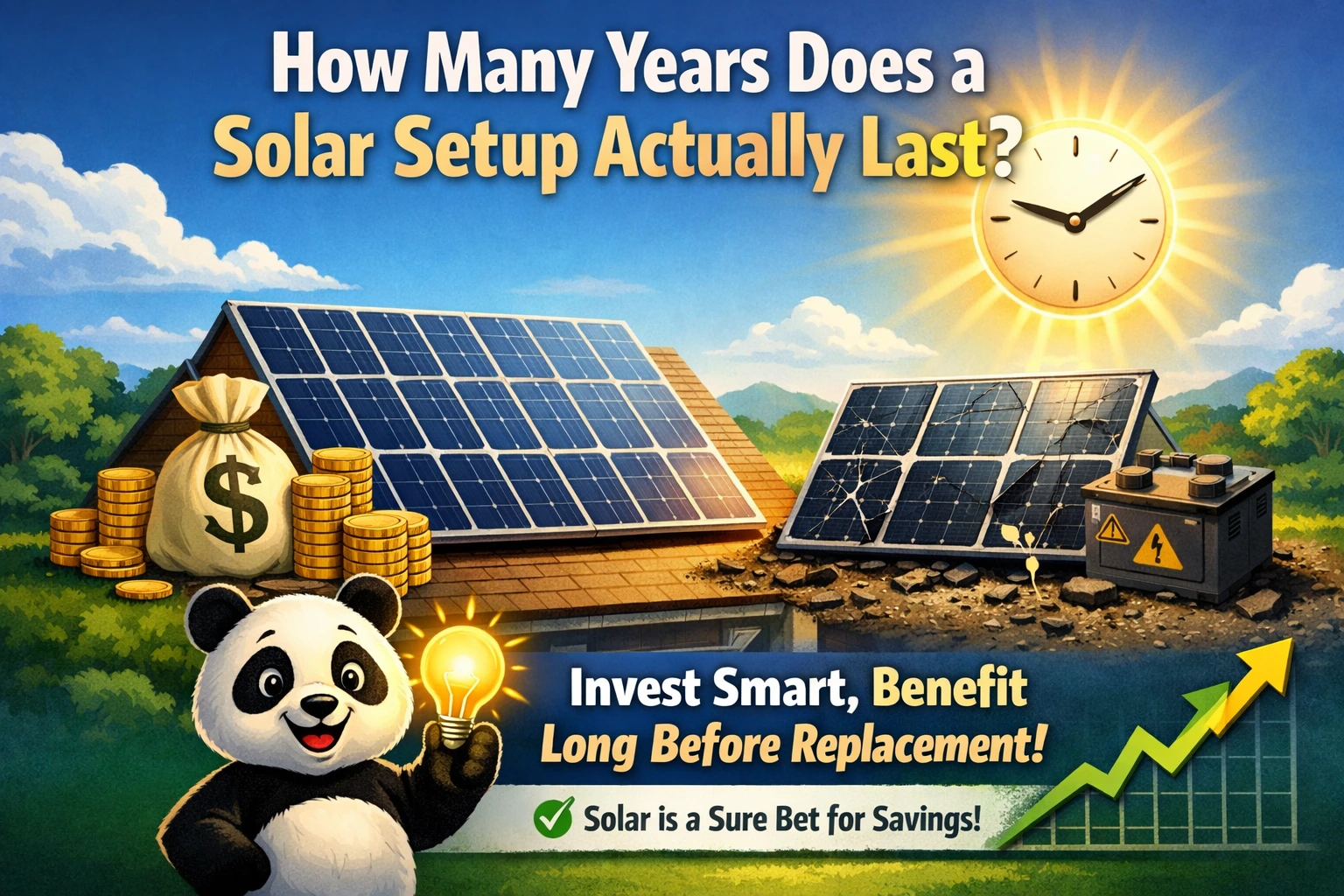
How Long Does a Solar Setup Actually Last? (Every Component Explained)
Let me guess — you've been thinking about going solar for a while now. You've done the research, you've seen the numbers, but there's still that one nagging question at the back of your mind:
"What if it breaks down before I even get my money back?"
It's a completely valid concern, and honestly, it's the question that stops most people from taking the leap. So let's answer it directly, component by component, with real numbers — so you can make a confident, informed decision.
Here's the short answer: most solar components will outlast your ROI period by years, sometimes decades. But let's dig into exactly why.
💡 TL;DR
Your solar setup will last far longer than it takes to pay for itself. Panels survive 25+ years, most components run 10–15 years, and you recover your investment in 3–5 years. The math always wins.
⚡ Quick Lifespan Overview
| Component | Average Lifespan |
|---|---|
| 🌞 Solar Panels | 25–30 years |
| 🔩 Mounting Hardware | 20–30 years |
| 🛡️ Circuit Breakers | 15–20 years |
| 🔌 DC Cables | 15–25 years |
| 🔗 MC4 Connectors | 15–25 years |
| 🎛️ MPPT/PWM Charge Controller | 10–15 years |
| 🔋 LiFePO4 Lithium Battery | 10–15 years |
| 🔌 Inverter | 10–15 years |
| 🔋 Gel Battery | 5–7 years |
| 🔋 Lead-Acid Battery | 3–5 years |
For context: a typical refrigerator lasts 10–15 years, an air conditioner 8–12 years. Most solar components outlast the appliances they're powering.
The key takeaway: In almost every case, you recover your investment long before any major component needs replacing. Solar isn't a gamble — it's a calculated win.
🌞 Solar Panels — The 25-Year Workhorse
⏳ Lifespan: 25–30 years
Solar panels are, without question, the most durable part of your entire system. Most tier-1 manufacturers offer a 25-year performance warranty, and many panels in the field are still producing power well past 30 years.
But here's what "lasting 25 years" actually means in practice. Solar panels don't suddenly stop working one day — they degrade slowly and gradually over time. A good quality panel degrades at roughly 0.5% per year. That means:
- After 10 years → still producing about 95% of original power
- After 25 years → still producing about 87–88% of original power
That's almost full power output for a quarter of a century. Compare that to your ROI period of just 3–5 years, and you can see why solar panels are considered one of the best long-term investments you can make for your home.
What Affects Panel Lifespan in the Philippines?
The Philippine climate is tough on equipment. Here's what to watch out for:
- Typhoons — Panels rated at IEC 61215 can withstand wind loads up to 2,400 Pa (roughly 220 km/h winds). Proper mounting is critical — panels that fail in storms usually fail because of the mount, not the panel itself.
- Coastal salt air — If you're within a few kilometers of the sea, choose panels with an IP68 junction box rating and aluminum frames with an anodized coating to resist corrosion.
- Extreme heat — Panels lose some efficiency on the hottest days, but this doesn't shorten their lifespan. Modern panels are designed to handle tropical temperatures.
Bottom line: Pay once. Enjoy clean, free electricity for 25+ years. Your ROI comes in year 3–5. Everything after that is pure savings.
🔋 Batteries — The Component That Varies the Most
Batteries are where lifespan varies the most depending on the type you choose. Let's break down the three most common options available in the Philippine market.
⚡ LiFePO4 Lithium — The Long-Term Champion
⏳ Lifespan: 10–15 years (3,000–6,000 charge cycles)
LiFePO4 (Lithium Iron Phosphate) batteries are the premium choice for a reason. They can handle deeper discharges (up to 80–90% depth of discharge without significant damage), charge faster, and require zero maintenance.
What makes them special in terms of lifespan is their cycle count. A typical LiFePO4 battery rated for 4,000 cycles, discharged once daily, would last over 10 years before reaching end of life — and even then, it still retains around 80% of its original capacity.
- ✅ Longest lifespan of all battery types
- ✅ No maintenance required
- ✅ Safest battery chemistry (no thermal runaway risk under normal use)
- ⚠️ Higher upfront cost — but the cost per cycle is actually the lowest
🟤 Gel Battery — The Middle Ground
⏳ Lifespan: 5–7 years
Gel batteries are a type of sealed lead-acid battery where the electrolyte is suspended in a silica gel, making them spill-proof and maintenance-free. They're a popular choice for homeowners who want something more reliable than flooded lead-acid without paying premium lithium prices.
They perform better than flooded lead-acid in heat, which makes them a decent option for Philippine conditions. However, they are sensitive to overcharging — a misconfigured charge controller can significantly shorten their life.
- ✅ Maintenance-free and spill-proof
- ✅ Better heat tolerance than flooded lead-acid
- ⚠️ Sensitive to overcharging — always pair with a quality charge controller
- ⚠️ Shorter lifespan than lithium
🪫 Lead-Acid (Flooded) — The Budget Starter
⏳ Lifespan: 3–5 years (with proper maintenance)
Flooded lead-acid batteries are the most affordable option and have been used in solar setups for decades. They work, but they come with the most demands — regular distilled water top-ups, proper ventilation due to off-gassing, and they must never be discharged below 50% to avoid accelerating degradation.
In the Philippines, lead-acid batteries are widely available at hardware stores and online marketplaces, making them easy to replace when needed.
- ✅ Cheapest upfront cost
- ✅ Widely available and easy to replace
- ❌ Requires regular maintenance
- ❌ Must be installed in a well-ventilated area
- ❌ Shorter lifespan — you may need to replace once before full ROI on the battery itself
Tip: Even if you start with lead-acid to save on upfront costs, plan to upgrade to LiFePO4 on your first battery replacement. By that time, lithium prices will likely be even more affordable than today.
🎛️ Solar Charge Controller — The Quiet Protector
⏳ Lifespan: 10–15 years
The charge controller doesn't get much attention, but it's quietly doing one of the most important jobs in your system — protecting your batteries from overcharging and over-discharging every single day.
A quality MPPT controller from a reputable brand (Zamdon, SRNE) is built to last well over a decade. Browse current models in our Charge Controller Finder. The key to longevity is heat management — charge controllers that run hot all the time degrade faster. Mount yours in a cool, shaded, well-ventilated location, and it will easily outlive your ROI period by many years.
Safety note: Always size your charge controller correctly for your panel array. An undersized controller running above its rated amperage will overheat and fail prematurely — and could damage your batteries in the process.
🔌 Inverter — Converting Power for Over a Decade
⏳ Lifespan: 10–15 years
The inverter is one of the hardest-working components in your system. It's converting DC power to AC constantly, every time you switch on a light or run an appliance. Despite this, a quality pure sine wave inverter is designed to handle this workload for 10–15 years under normal operating conditions. Compare reliable units with the Inverter Finder.
The biggest threats to inverter lifespan are:
- Overloading — Running the inverter at or above its rated wattage consistently shortens its life. Always size with a 20–25% headroom above your peak load.
- Poor ventilation — Inverters generate heat. Install yours in a location with good airflow, away from direct sunlight.
- Power surges — A proper breaker on the AC output side protects the inverter from surges coming from your appliances.
Warning: Cheap inverters from unknown brands may last only 1–3 years. Invest in a reputable brand — it's one of the components where cutting corners costs more in the long run.
🛡️ Circuit Breakers — Set It and (Almost) Forget It
⏳ Lifespan: 15–20 years
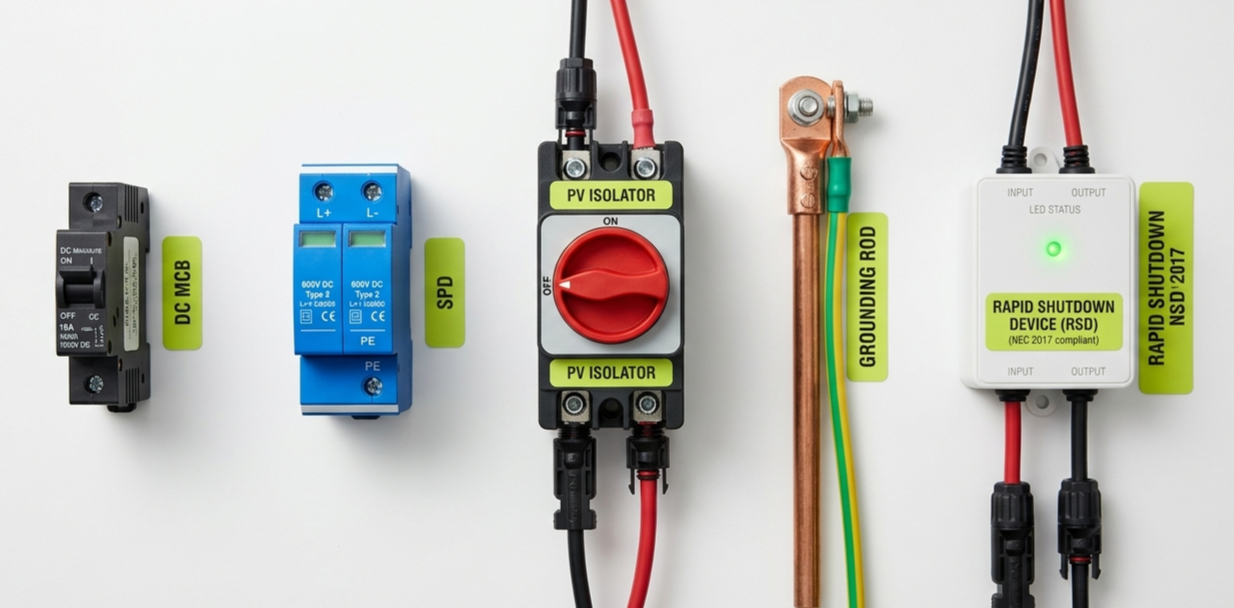
Circuit breakers are arguably the longest-lasting component in your solar system. A quality DC-rated breaker installed correctly can last 15 to 20 years with virtually zero maintenance — it just sits there, ready to protect your system the moment something goes wrong.
What shortens a breaker's life is repeated tripping under overload conditions. If a breaker is tripping regularly, that's a sign your system is drawing more current than it should — the breaker is doing its job, but the root cause needs to be addressed.
Why Breakers Are Non-Negotiable for Safety 🔴
In a solar system, you're dealing with DC electricity at high current levels — especially between the battery bank and the inverter. DC current is significantly more dangerous than AC current at the same voltage because:
- It doesn't cycle to zero like AC does, making it harder to interrupt safely
- A DC arc (spark) can sustain itself and cause fires if not properly interrupted
- Battery banks can deliver extremely high short-circuit currents — thousands of amps in a fault condition
Critical safety rule: Always use DC-rated breakers on DC circuits. Standard AC breakers are not designed to safely interrupt DC current and can fail catastrophically in a fault condition. This is one of the most common — and most dangerous — mistakes in DIY solar builds.
🔌 Wiring, Connectors & Mounting — The Forgotten Long-Haulers
These components rarely make it into lifespan discussions, but they're just as important — and most of them will outlast almost everything else in your system.
DC Solar Cables
⏳ Lifespan: 15–25 years
Quality solar DC cables use XLPE (cross-linked polyethylene) or USE-2/PV Wire insulation — both rated for direct burial, UV exposure, and the extreme heat of a Philippine rooftop. A properly sized and secured cable run will typically last the full lifetime of your panel array.
What degrades cables prematurely:
- Undersizing — A cable running at 80–100% of its rated current runs hot and degrades insulation faster. Always size for at least 125% of your circuit's maximum current.
- Exposed UV damage — Unprotected cable runs (not in conduit, not self-sheathed) degrade significantly faster in direct tropical sunlight.
- Rodent damage — In Philippine homes, rats are a real threat. Any cable run accessible to rodents should be in metal conduit.
MC4 Connectors
⏳ Lifespan: 15–25 years
MC4 connectors are the weatherproof plug-and-lock connectors that join solar panels together in series or parallel strings. When properly mated and rated IP67 or IP68, they are extremely durable. But they are also one of the most common sources of arc faults in aging solar systems.
What to watch for over time:
- Moisture ingress — Connectors that weren't fully clicked together, or cheaply made connectors with poor seals, allow water into the connection over time. This causes resistance, heating, and eventually arcing.
- Mixing brands — MC4 connectors from different manufacturers should not be mixed. The tolerances are slightly different, and a poor seal is the result.
Inspection tip: During your annual panel check, look for discoloration or melting around MC4 connectors. Any connector that looks brown, warped, or cracked should be replaced immediately — a failing MC4 connector is a fire hazard.
Mounting Hardware & Racking
⏳ Lifespan: 20–30 years
Solar mounting hardware — the rails, clamps, and brackets that hold your panels to your roof — is often the most overlooked part of a solar installation. In the Philippines, this is actually one of the most critical components because of typhoons.
A properly engineered mount uses:
- Hot-dip galvanized steel or marine-grade aluminum — Both resist the salt air that destroys regular steel in coastal areas. Avoid regular painted steel — it will rust through in 5–10 years in a coastal environment.
- Correct wind-load ratings — Philippine standards (NSCP 2015) require roof mounts to handle wind pressures for the applicable typhoon zone. Ask your installer for the wind-load calculation.
- Roof penetration waterproofing — Every bolt that goes through your roof is a potential leak. Use EPDM-sealed lag bolts and inspect the sealant every 3–5 years.
Philippine tip: If you're in a typhoon-prone area (Signal No. 3+ history), consider a lower tilt angle (10–15°) rather than the optimal 15–18° for your latitude. Lower tilt dramatically reduces wind uplift force on your array.
Inline Fuses
⏳ Lifespan: 10–15 years (or indefinitely if not triggered)
A fuse that never blows can last indefinitely — fuses are passive devices with no moving parts. However, the fuse holder is the component that ages. In humid Philippine conditions, fuse holders can corrode, creating resistance at the connection point. Inspect and clean fuse holders every 1–2 years, and replace any holder with visible corrosion. Always replace a blown fuse with the identical amperage and DC voltage rating — never upsize a fuse to stop it from tripping.
📊 The ROI Timeline — Why the Numbers Always Work in Your Favor
Let's bring this all together with a real example. Say you build a mid-range solar setup for a Filipino home:
📋 Sample Setup — ₱5,000/month electricity bill
💰 System cost: ~₱196,000
📅 ROI: 3 years and 3 months
☀️ Panels: 25–30 years
🔋 LiFePO4 battery: 10–15 years
🎛️ Controller: 10–15 years
🔌 Inverter: 10–15 years
🏆 After ROI, you save ~₱60,000/year — for 20+ more years. That's over ₱1,200,000 in total savings.
Even if you need to replace your batteries once or twice over the panel's lifetime, the math still works overwhelmingly in your favor. The panels — your biggest ticket item — keep producing long after everything else has already paid for itself.
🔄 The Component Lifecycle at a Glance
🌞 Solar Panels
25–30 yrs
🔩 Mounting
20–30 yrs
🛡️ Breakers
15–20 yrs
🔌 DC Cables
15–25 yrs
🔗 MC4 Connectors
15–25 yrs
⚡ LiFePO4
10–15 yrs
🎛️ Controller
10–15 yrs
🔌 Inverter
10–15 yrs
🟤 Gel Battery
5–7 yrs
🪫 Lead-Acid
3–5 yrs
ROI Period →
✅ ROI at year 3–5
❓ Frequently Asked Questions
How long do solar panels last in the Philippines?
Quality tier-1 solar panels last 25–30 years in Philippine conditions. Panels certified to IEC 61215 can withstand typhoon-force wind loads up to 2,400 Pa (approximately 220 km/h). The main climate threats aren't wind or heat — panels are engineered for tropical temperatures — but salt air corrosion if you live near the coast. For coastal installations, specify panels with an IP68-rated junction box and an anodized aluminum frame. Panel output degrades slowly at ~0.5%/year, so at year 25 your panels are still producing about 87–88% of their original power.
When will a solar setup pay for itself in the Philippines?
For a typical Filipino home with a ₱5,000/month electricity bill, a properly sized solar setup (around ₱196,000 installed) pays for itself in approximately 3 years and 3 months. Homes with higher bills (₱8,000–₱15,000/month) often see payback in under 2.5 years. After ROI, your savings are effectively pure income — a ₱5,000/month bill translates to roughly ₱60,000 per year in free electricity for the next 20+ years.
What is the lifespan of a LiFePO4 battery in the Philippines?
A LiFePO4 (Lithium Iron Phosphate) battery lasts 10–15 years in typical residential solar use, rated for 3,000–6,000 charge cycles. Cycling once per day, a 4,000-cycle battery reaches end-of-rated-life in about 11 years — and even then, it retains approximately 80% of its original capacity. In Philippine conditions, keep your LiFePO4 battery in a shaded, ventilated space; extreme heat (above 45°C) slightly accelerates degradation. Compared to lead-acid, the higher upfront cost works out to a significantly lower cost per kWh stored over the battery's lifetime.
Do solar panels lose efficiency over time?
Yes, but very slowly. The industry standard degradation rate for quality panels is ~0.5% per year. That means:
- After 10 years → ~95% of original power output
- After 20 years → ~90% of original power output
- After 25 years → ~87–88% of original power output
Cheap panels can degrade at 1–2% per year, which is why tier-1 panels with a linear performance warranty are worth the premium. In practical terms, even at year 25, your panels are still generating nearly full power — more than enough to cover your household load.
How often do you need to replace solar batteries?
It depends on which battery type you choose:
- Lead-acid (flooded): Every 3–5 years with proper maintenance
- Gel battery: Every 5–7 years
- LiFePO4 lithium: Every 10–15 years
Most homeowners who start with lead-acid end up replacing batteries once or twice over the life of their system. With LiFePO4, most people only replace batteries once — near the end of the panel's 25-year life. If you're doing a fresh installation today, LiFePO4 is almost always the better long-term investment.
What part of a solar setup fails first?
Batteries — specifically lead-acid batteries — are almost always the first component to reach end of life, typically within 3–5 years. After that, inverters are the next most likely failure point, usually after 10+ years (capacitor wear is the most common cause of inverter failure in older units). Solar panels almost never fail outright — they just slowly produce slightly less power year after year. Charge controllers and breakers rarely fail if they're correctly sized and installed in a ventilated location.
🏁 Final Thoughts — Stop Waiting, Start Saving
The question was never really "Will my solar setup last long enough?" — the real question is "How much am I losing every month I wait?"
If your electricity bill is ₱5,000/month, that's ₱60,000 a year going straight to your distribution utility. Every year you delay is another ₱60,000 that could have been working toward your solar ROI instead.
With panels that last 25–30 years, controllers and inverters that run for 10–15 years, and an ROI you can hit in as little as 3 years — solar is one of the few investments that genuinely keeps paying you back long after you've recouped every peso.
The best time to go solar was five years ago. The second best time is today. 🌞
Ready to see exactly what a setup would cost for your home? Use our FREE Solar Setup Calculator and get your personalized ROI estimate in minutes. 🚀
Want to keep learning? Browse more guides in our Solar Blog — from wiring sizes to battery comparisons. 📚