☀️ Solar Basics🇵🇭 Philippines🔌 DIY Friendly🛡️ Safety-Focused
What Are the Main Functions of a Hybrid Inverter?
Last updated: June 2026 · 8 min read · By Solar Panda
If you've been researching solar setups in the Philippines, you've probably come across the term hybrid inverter more than once. It sounds technical, but once you understand what it actually does — and why it matters — it becomes one of the easiest components to appreciate.
A hybrid inverter isn't just an inverter. It's the command center of your entire solar system. It manages power coming in from your panels, decides how to charge your batteries, and delivers clean electricity to your home — all while keeping your entire setup safe from electrical faults that could damage your equipment or, worse, cause a fire.
💡 TL;DR
A hybrid inverter does six key jobs: it charges your batteries from solar, converts solar current to the right battery voltage, converts DC battery power to 220V AC for your appliances, protects your battery from overload and overcurrent, automatically cuts connections when something goes wrong, and provides several other built-in safety features — all in one unit.
⚡ How a Hybrid Inverter Fits Into Your System
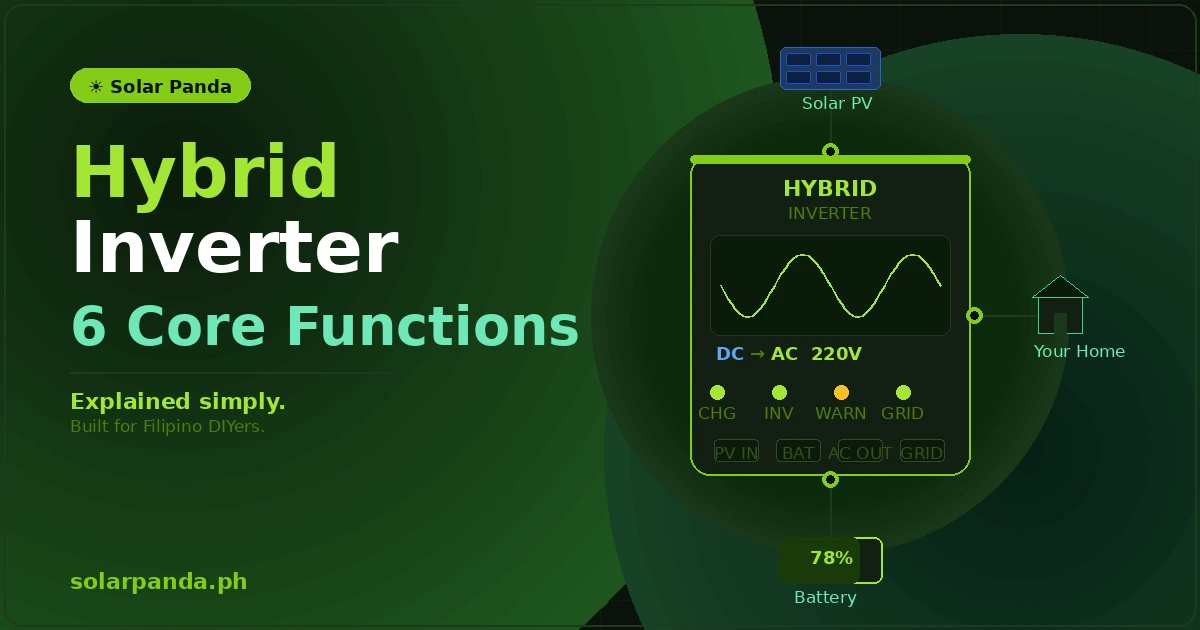
Before diving into each function, here's how power flows through a hybrid inverter in a typical Filipino home setup:
☀️ Solar Panels
→
🔧 Hybrid Inverter
→
🔋 Battery Bank
→
🏠 Your Appliances
⚡ Grid (Optional)
→
🔧 Hybrid Inverter
→
🔋 Battery / 🏠 Home
The hybrid inverter sits at the center of every single power path. Nothing moves without going through it — and that's exactly why its built-in protections are so critical.
The 6 Core Functions of a Hybrid Inverter
1
Charging the Battery
Managing how and when your battery fills up
The most fundamental job of any hybrid inverter is managing battery charging — and it does this far more intelligently than a simple charger ever could.
A hybrid inverter monitors your battery's state of charge (SOC) in real time and adjusts the charging current accordingly. It follows a standard three-stage charging cycle:
| Stage | What Happens | When It Applies |
|---|---|---|
| ⚡ Bulk | Maximum current pushed into battery until ~80% full | Battery is low — fast charging phase |
| 🔄 Absorption | Voltage held constant, current tapers down | 80–100% range — prevents heat buildup |
| 🌙 Float | Trickle charge to maintain full charge without overcharging | Battery is full — maintenance mode |
This multi-stage approach is critical for battery longevity. A battery that's always charged with raw, unregulated current will degrade much faster. The hybrid inverter's charging management is one of the key reasons a well-maintained LiFePO4 battery can last 10–15 years instead of failing early.
It can also pull charging current from multiple sources simultaneously — your solar panels and the grid — and prioritize solar first to maximize your savings.
Tip: Many hybrid inverters let you set a minimum SOC threshold — for example, never discharging below 20%. This one setting alone can double the lifespan of a lead-acid or gel battery.
2
MPPT: Converting Solar Current to Battery Voltage
Getting the most out of every ray of sunlight
Solar panels produce variable DC voltage that fluctuates constantly depending on sunlight intensity, cloud cover, temperature, and shading. A 400W panel might output anywhere from 30V to 48V throughout the day. Your battery, however, needs a specific, stable voltage to charge safely — typically 12V, 24V, or 48V depending on your system.
This is where the MPPT (Maximum Power Point Tracker) built into your hybrid inverter does its magic.
The MPPT circuit continuously sweeps the panel's voltage-current curve to find the exact operating point that produces the maximum power at any given moment. It then steps that voltage down (or up) to match your battery's required charging voltage — all while preserving as much of the panel's energy as possible.
Real-world impact: An MPPT controller typically recovers 15–30% more energy from your panels compared to an older PWM-type controller. On a 2kW panel array generating ₱15,000 worth of electricity per year, that's an extra ₱2,250–₱4,500 in annual savings — just from smarter voltage conversion.
Most hybrid inverters also handle multiple MPPT inputs, which lets you connect solar panels facing different directions (e.g., east and west-facing roof sections) or at different tilt angles — and optimize each string independently. This is particularly useful for Filipino homes with irregular rooflines.
3
Providing Electricity — DC to AC Conversion
Making solar power usable for your appliances
Your batteries store power as direct current (DC) — the same type of current that flows from a battery terminal. But almost every appliance in your home — your refrigerator, TV, aircon, lights, and phone chargers — runs on alternating current (AC) at 220V, 60Hz, which is the Philippine standard.
The hybrid inverter's built-in inverter stage converts that DC battery power into clean pure sine wave AC power that's indistinguishable from what your distribution utility provides.
Why pure sine wave matters:
| Appliance Type | Modified Sine Wave | Pure Sine Wave ✅ |
|---|---|---|
| LED lights, phone chargers | Works (may hum) | Works perfectly |
| Refrigerators, fans | ⚠️ Motor runs hot, shorter life | Works perfectly |
| Air conditioners | ❌ May not start or get damaged | Works perfectly |
| Medical equipment | ❌ Unsafe — do not use | Works perfectly |
| Inverter-type appliances | ❌ Likely damaged over time | Works perfectly |
A hybrid inverter's output is always pure sine wave — this isn't optional, it's a fundamental design requirement. The inverter also handles seamless switching between solar/battery power and the grid, often in under 20 milliseconds — so fast that most appliances don't even notice the transition.
For Filipino homes: If you have a split-type aircon (the most common setup here), you must use pure sine wave output. Modified sine wave will cause your aircon compressor to overheat and fail — an expensive mistake that a hybrid inverter's built-in pure sine wave output prevents entirely.
4
Battery Protection — Overload & Overcurrent Prevention
The guardian that keeps your battery alive longer
Batteries are expensive. A 100Ah LiFePO4 battery bank can cost ₱20,000–₱60,000 depending on capacity. Protecting that investment is a top priority — and the hybrid inverter takes this job seriously.
There are two key protection mechanisms at work here:
Overload Protection kicks in when the total power drawn from the inverter exceeds its rated capacity. For example, if you have a 3kW inverter and you try to run 3.5kW worth of appliances simultaneously, the inverter will either throttle the output or shut down gracefully to prevent damage. This protects both the inverter's internal components and your battery from being drained at a dangerously high rate.
Overcurrent Protection monitors the current flowing in and out of the battery bank. Batteries have a maximum charge and discharge current rating — exceeding it causes excessive heat, accelerates degradation, and in worst cases, can cause swelling or venting (in lead-acid types). The hybrid inverter enforces these current limits automatically, acting as a software-based fuse that responds far faster than any physical breaker.
Important: These software protections do not replace physical breakers. You still need properly rated DC breakers between your battery bank and inverter. Software protection and hardware protection work together — one is not a substitute for the other.
5
Auto-Cut Connections
The system that shuts down before things go wrong
One of the most underappreciated features of a hybrid inverter is its ability to automatically disconnect circuits when preset thresholds are crossed — without any human intervention. This is your last line of software defense before physical damage occurs.
Here are the key auto-cut triggers built into most quality hybrid inverters:
| Trigger | What It Does | Why It Matters |
|---|---|---|
| 🔋 Low Battery (LVD) | Disconnects load when battery hits minimum SOC | Prevents deep discharge that kills lead-acid batteries permanently |
| 🌡️ Over-temperature | Reduces output or shuts down if internal temp exceeds safe limit | Prevents thermal damage to inverter components |
| ⚡ Over-voltage (PV) | Disconnects panel input if voltage exceeds rated maximum | Protects MPPT circuitry from voltage spikes |
| ⚡ Over-voltage (Battery) | Stops charging if battery voltage rises above safe limit | Prevents overcharging — critical for gel and LiFePO4 |
| 🔌 Grid Fault (Anti-Islanding) | Disconnects from grid during outage | Protects utility workers from backfed power during repairs |
The anti-islanding protection deserves special mention. In the Philippines, net metering allows you to feed excess solar power back to the grid. But if there's a power outage and your inverter keeps feeding power into the grid, it creates a dangerous condition called islanding — where a section of the grid appears de-energized to utility workers but is actually still live. Anti-islanding protection detects the grid outage within milliseconds and disconnects your system automatically, keeping linemen safe.
Safety-critical: If you're on net metering with Meralco, DLPC, or any DU, your hybrid inverter must have certified anti-islanding protection. This is a legal requirement under the Philippine net metering regulations, not just a recommendation.
6
Additional Safety Features
The full protection stack that responsible solar demands
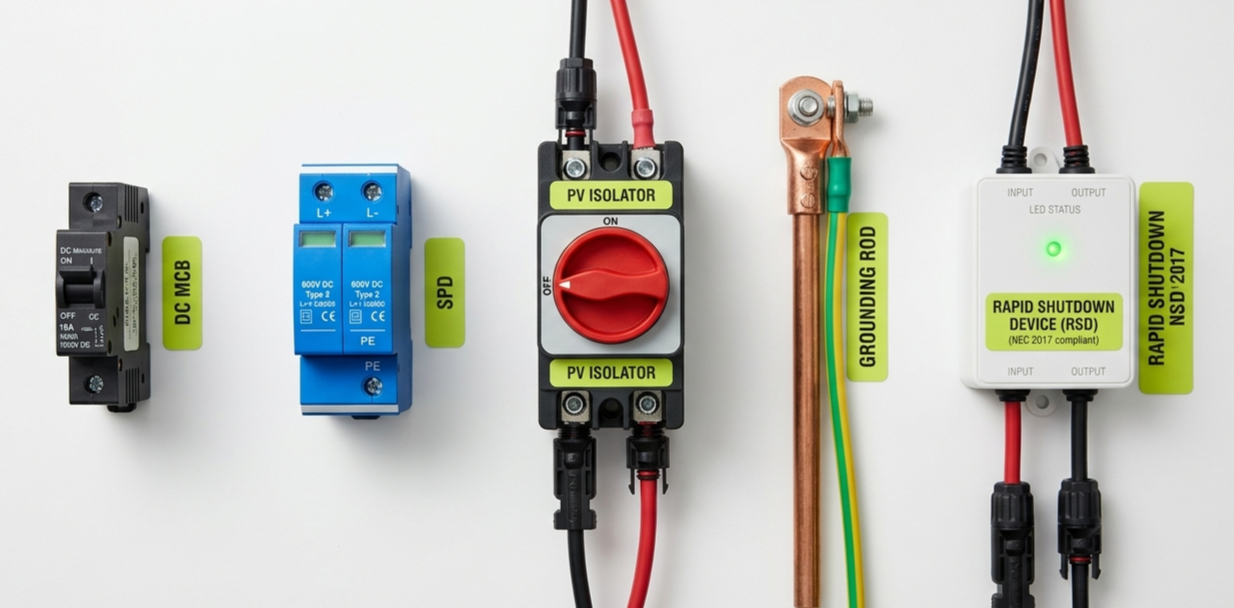
Beyond the five core functions above, quality hybrid inverters include a comprehensive safety stack that protects every part of your system — and your home.
Non-negotiable: Never bypass or disable any of these safety features to "save money" or "simplify the setup." Each one exists because a real-world failure scenario — tested and documented — required it. A single electrical fault in a solar system can cause a house fire within minutes.
🔄 Why "Hybrid" — What Makes It Different From a Regular Inverter?
A standard grid-tie inverter can only work when the grid is present — if there's a brownout, it shuts down completely. A standard off-grid inverter works without the grid but can't connect to it.
A hybrid inverter does both — it can operate in:
| Mode | Power Sources Used | Best For |
|---|---|---|
| ☀️ Solar Priority | Solar first → Battery → Grid as backup | Maximizing savings during daylight hours |
| 🔋 Battery Priority | Battery first → Solar → Grid as backup | Brownout protection, using stored power at peak rate times |
| ⚡ Grid Priority | Grid first → Solar charges battery | Low-sun periods, battery conditioning |
| 🏝️ Off-Grid | Solar + Battery only, no grid connection | Remote locations, full energy independence |
For most Filipino homeowners — especially those dealing with Meralco's rising rates and frequent brownouts — the Solar Priority mode is the default sweet spot: free solar power during the day, battery backup through the night, and the grid only as a last resort.
🏁 Final Thoughts
A hybrid inverter is the single most important component you'll buy for your solar setup. It's not just a box that converts electricity — it's an intelligent power manager, a battery guardian, a safety monitor, and a grid interface all in one.
Understanding what it does — and why each function matters — means you can shop smarter, configure it correctly, and maintain your system with confidence. When you're ready to pick a model, our Hybrid Inverter Finder matches units to your load and battery plan.
🌞 Ready to Build Your Solar Setup?
Use our free calculator to find the right hybrid inverter size and battery bank for your home — based on your actual monthly consumption.
Try the Free Solar Calculator →