🔋 Battery Guide🇵🇭 Philippines📅 2026 Updated🛡️ Safety-Focused
Different Types of Solar Batteries in the Philippines (2026 Guide)
Updated: June 2026 · 5 min read · By Solar Panda
Choosing the right battery is one of the most important — and most confusing — decisions in any solar build. The wrong choice means replacing it sooner than expected, paying more in the long run, or worse, creating a safety hazard at home. Here's a no-fluff breakdown of every battery type available in the Philippine market and exactly when to use each one.
1. Flooded Lead-Acid (FLA)
Also called: Wet Cell, Open-Cell Battery
⏳ 3–5 years · 300–500 cyclesThe oldest and cheapest option on this list. FLA batteries use lead plates submerged in liquid sulfuric acid. Because the electrolyte is exposed to the atmosphere, it slowly evaporates — meaning you need to top it up with distilled water monthly. It also releases hydrogen gas while charging, which is explosive in enclosed spaces.
In our tropical climate, FLA batteries are severely affected by heat. At a typical Philippine summer temperature of 35°C, they can lose up to 50% of their rated capacity and degrade twice as fast as rated.
Price (100Ah 12V)
₱4,000–₱7,000
Usable DoD
50%
Maintenance
Monthly
Indoor-Safe
❌ No
🎯
Best for: Outdoor or well-ventilated setups (bodega, farm shed, provincial outdoor enclosure) where budget is the top priority. Plan to upgrade to LiFePO4 on your first replacement.
🔴
Never install FLA batteries in an enclosed indoor space. Hydrogen off-gassing + a single spark = fire and explosion risk.
2. Sealed AGM Battery
Absorbent Glass Mat — sealed lead-acid
⏳ 4–7 years · 500–900 cyclesAGM batteries absorb the electrolyte into a fiberglass mat, making them completely sealed, spill-proof, and maintenance-free. No water top-ups, no off-gassing under normal use, and safe to install indoors. They also handle high surge currents well — good for appliances like refrigerators and aircons that draw a heavy startup load.
The trade-off is sensitivity to overcharging. Always pair AGM with a quality charge controller set to the correct AGM voltage profile. A swollen AGM battery from overcharging must be replaced immediately.
Price (100Ah 12V)
₱8,000–₱15,000
Usable DoD
50–80%
Maintenance
None
Indoor-Safe
✅ Yes
🎯
Best for: Indoor residential setups, apartments, townhouses, and home office backup systems where you want a clean, zero-maintenance experience without paying lithium prices.
3. Gel Battery
Gel Cell — silica-thickened sealed lead-acid
⏳ 5–7 years · 500–800 cyclesGel batteries mix the electrolyte with silica into a thick gel. The result is a sealed, spill-proof battery that can be mounted in any orientation and handles heat better than both FLA and AGM — making it well-suited for hot Philippine conditions. It also recovers from deep discharge better than the other lead-acid types.
The critical weakness: gel batteries are extremely sensitive to fast charging. Overcharging causes the gel to crack internally, permanently destroying capacity. You must use a charge controller with a dedicated Gel mode — not an AGM or generic profile.
Price (100Ah 12V)
₱12,000–₱25,000
Usable DoD
50–80%
Maintenance
None
Heat Tolerance
✅ Good
🎯
Best for: Remote hot-area setups, provincial off-grid homes, and marine applications (boats, fishing vessels) where heat tolerance and flexible mounting matter more than charge speed.
⚠️
If your charge controller doesn't have a dedicated Gel mode, do not use a gel battery with it.
4. Lithium Iron Phosphate (LiFePO4 / LFP)
The 2026 gold standard for home solar storage
⏳ 10–15 years · 4,000–10,000 cyclesLiFePO4 is the best battery choice for the vast majority of Filipino homeowners today — and the numbers explain why. It lasts 3–4× longer than any lead-acid type, delivers 80–90% usable capacity (vs 50% for lead-acid), requires zero maintenance, and is safe indoors with no off-gassing or thermal runaway risk.
In Philippine heat — regularly 33°C–38°C — LFP maintains near-full performance while lead-acid batteries degrade sharply. The higher upfront cost is offset by a far lower cost-per-year: one LFP battery lasting 12 years beats three FLA replacements over the same period, financially and practically.
Entry-level local brands (X-Power, LvtopSun on Shopee/Lazada) start at ₱12,500 per 100Ah. Premium brands with verified warranties (Invicta, EG4, Victron) cost more but come with 10-year coverage. See how brands stack up by price in our battery brand tiers.
Price (100Ah 12V)
₱12,500–₱40,000+
Usable DoD
80–90%
Maintenance
None
Indoor-Safe
✅ Yes
🎯
Best for: Virtually every home solar installation in the Philippines. Especially recommended for daily cycling setups, urban homes with limited ventilation, and anyone who wants maximum lifespan with zero maintenance.
💡
Check the BMS. The Battery Management System inside every LFP battery is what separates a 10-year battery from one that fails in 2. Always verify the brand offers a minimum 2-year warranty and real cycle life data before buying.
5. Sodium-Ion Battery (Na-Ion)
The emerging 2026 technology worth watching
⏳ 10–15 years · 4,000–5,000 cyclesSodium-Ion is the biggest battery story of 2026. Major manufacturers like CATL and BYD have ramped commercial production this year, and the technology is starting to appear in home storage products. It uses sodium — roughly 1,000 times more abundant than lithium — which promises lower long-term costs as production scales up.
For Philippine conditions, Na-Ion's thermal stability is genuinely excellent — it handles high ambient temperatures well and can even be fully discharged to 0 volts without permanent damage. Pricing in 2026 is already competitive with LFP.
The catch: local availability and after-sales support in the Philippines are still very limited. LFP has decades of proven real-world data; Na-Ion at residential scale is brand new. Also check inverter compatibility — its wider voltage range per cell means not all existing inverters support it.
Price (2026)
Comparable to LFP
Usable DoD
80–100%
Maintenance
None
Local Support
⚠️ Limited
🎯
Best for: Tech-forward early adopters with access to a local supplier offering solid after-sales support. Not yet recommended as the primary choice for most homeowners — revisit in 2027 as the local market matures.
📊 Side-by-Side Comparison
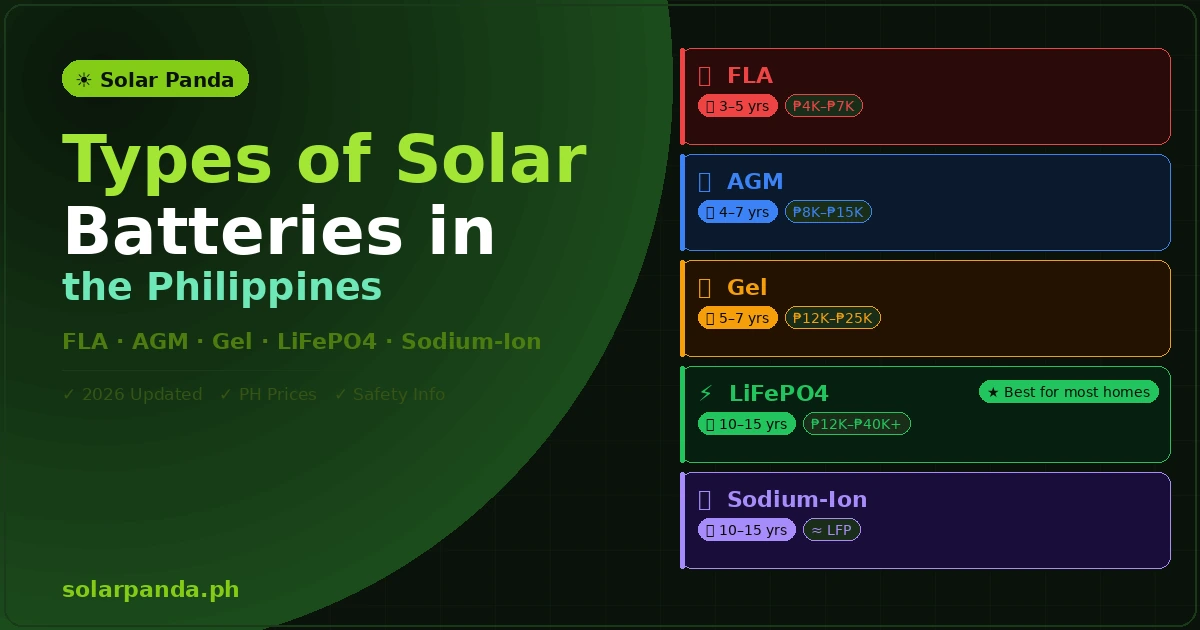
| Type | Price (100Ah) | Lifespan | DoD | Maintenance | PH Heat |
|---|---|---|---|---|---|
| 🪫 FLA | ₱4K–₱7K | 3–5 yrs | 50% | Monthly | ❌ Poor |
| 🔵 AGM | ₱8K–₱15K | 4–7 yrs | 50–80% | None | ⚠️ Moderate |
| 🟡 Gel | ₱12K–₱25K | 5–7 yrs | 50–80% | None | ✅ Good |
| ⚡ LiFePO4 | ₱12K–₱40K+ | 10–15 yrs | 80–90% | None | ✅ Excellent |
| 🔮 Na-Ion | ~LFP | 10–15 yrs | 80–100% | None | ✅ Excellent |
Bottom line: If budget is your only constraint, start with FLA outdoors or AGM indoors. For everyone else, LiFePO4 is the right answer in 2026 — lower cost per year, longest lifespan, safest chemistry, and zero maintenance. The higher upfront cost pays for itself faster than most people expect. Check live local prices anytime with Magkano Online?
🌞 Not Sure How Many Batteries You Need?
Use the Solar Panda Calculator to get a personalized battery bank size based on your monthly consumption.
Calculate My Battery Bank →