☀️ Solar Basics🇵🇭 Philippines🌦️ Weather Guide📅 2026 Updated
What Are Peak Sun Hours? How Philippine Weather Affects Your Solar Output
If you've sized a solar system or compared quotes, you've probably seen the term PSH — Peak Sun Hours. It sounds technical, but it's actually one of the most practical numbers in all of solar. It tells you exactly how much energy your panels will produce on a given day, in any weather condition.
And since the Philippines experiences everything from blazing summer sun to category-5 typhoons, understanding how each weather type affects your PSH — and your real-world solar output — is essential knowledge for every Filipino solar homeowner.
💡 TL;DR
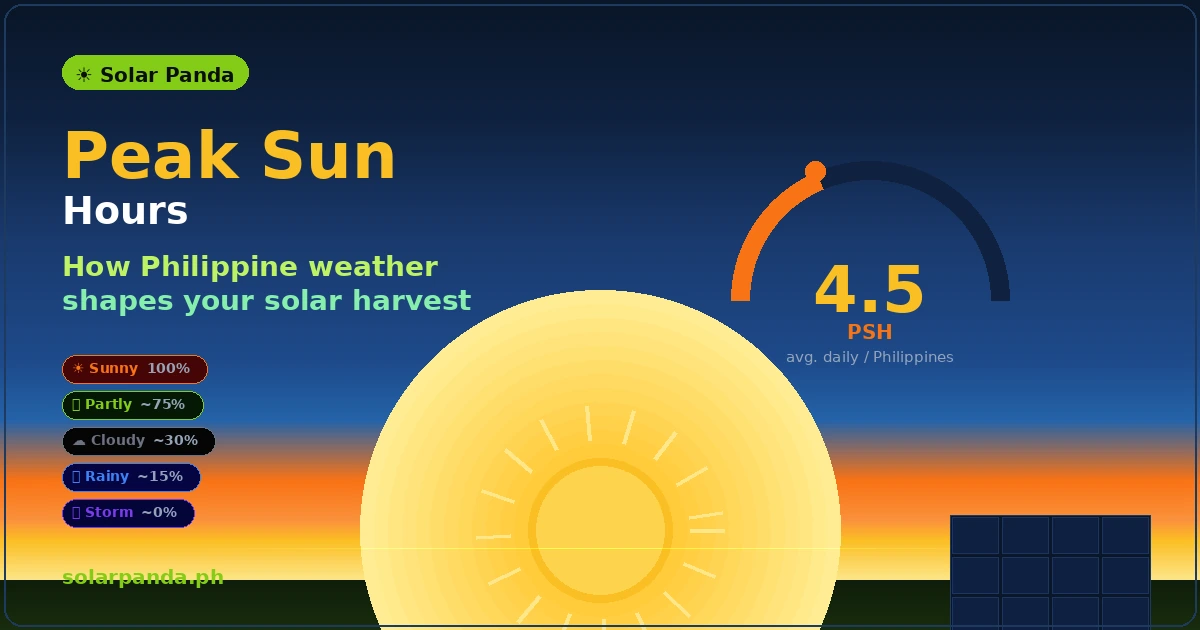
Peak Sun Hours (PSH) = the number of hours per day that solar irradiance hits 1,000W/m². The Philippines averages 4–5.5 PSH daily. Sunny days maximize output. Partly cloudy is surprisingly nearly as good. Full overcast drops to 30–50%. Rain cuts to 10–20%. Typhoons = near zero, and you should have your system off anyway.
☀️ What Exactly Are Peak Sun Hours?
Peak Sun Hours are not the same as daylight hours. The Philippines gets roughly 11–12 hours of daylight every day — but your panels are nowhere near full power for all of those hours.
Peak Sun Hours (PSH) is defined as the number of equivalent hours per day during which solar irradiance averages 1,000 watts per square meter (W/m²) — the standard test condition used to rate all solar panels.
Think of it like a water faucet. Daylight is how long the tap is turned on. PSH is how many of those hours the water was running at full blast. In the early morning and late afternoon, the sun's angle is low — it's just a trickle. Peak production happens in the middle of the day when the sun is directly overhead.
1 PSH = 1 hour of 1,000 W/m² irradiance
A 500W panel under 1 PSH produces approximately 500Wh (0.5kWh) of electricity
By adding up all the varying irradiance throughout the day — the morning trickle, the midday peak, and the afternoon fade — we express the total as equivalent "full-blast" hours. That's your PSH for that day.
🗺️ Philippines PSH by Region
The Philippines sits near the equator, giving it some of the best solar potential in the world. Our average national PSH is remarkably strong:
Metro Manila / Luzon
Average daily PSH
4.5–5.0
Visayas
Average daily PSH
4.8–5.3
Mindanao
Average daily PSH
5.0–5.5
Mountainous Areas
Average daily PSH
4.0–4.5
Even at the conservative end of 4.0 PSH, a 1kW solar system still produces 4kWh per day — enough to run a refrigerator and your lights through the night.
🌦️ How Each Weather Type Affects Your PSH
Sunny / Clear Sky
Best overall production — but heat has a hidden cost
Panel Output85–100% of rated capacity
⏳ PSH: 4.5–5.5 hrs/day in PH
Clear, sunny days produce the highest total energy output of any weather condition. Your panels are receiving close to or at 1,000W/m², and your PSH matches real daylight hours as closely as possible.
However, there's a detail many solar guides skip: extreme heat actually reduces panel efficiency. Solar panels have a temperature coefficient — every degree above 25°C causes a small loss in output (typically -0.3% to -0.45% per °C). On a Philippine summer afternoon where panels can reach 60–70°C on the surface, this heat loss can reduce actual output by 10–20% compared to the panel's rated wattage.
This is why a bright but slightly cooler morning — say 8AM to 11AM — often produces higher efficiency per panel than the scorching 1PM peak, even though irradiance is highest at noon.
💡
The real sweet spot isn't midday blazing heat — it's a bright, cool morning after overnight rain. Panels are clean, temperatures are lower, and irradiance is already strong. This is when you'll see your highest efficiency readings.
Partly Cloudy
Better than you think — and sometimes briefly better than full sun
Panel Output60–90% of rated capacity
⏳ PSH: 3.0–4.5 hrs/day equivalent
Partly cloudy days are far less damaging to production than most people expect. When light passes through thin clouds or around their edges, it scatters as diffuse light — which solar panels can still convert to electricity effectively.
There's also a fascinating phenomenon called the "edge of cloud" effect: when the sun passes alongside the edge of a cloud, the light can briefly intensify — causing your panels to momentarily exceed their rated wattage. These spikes are short-lived, but they help offset the energy lost during cloudier moments.
⚡
Edge of cloud effect: During partly cloudy days, solar panels can briefly produce more than their rated capacity as concentrated light passes cloud edges. Your inverter handles this automatically — it's a feature, not a fault.
Heavily Overcast / Full Cloud Cover
Reduced but not zero — your system still works
Panel Output10–50% of rated capacity
⏳ PSH: 1.0–2.5 hrs/day equivalent
Dense cloud cover significantly reduces irradiance reaching your panels — but it doesn't reduce it to zero. Clouds block direct sunlight while still allowing diffuse scattered light to reach your panels. Modern monocrystalline panels are particularly good at converting this lower-intensity diffuse light.
A good rule of thumb: a fully overcast sky reduces panel output to 30–50% of a clear day. On a light overcast day, you may still hit 50–70%. The Philippines' rainy season months (June–October) bring extended overcast stretches, which is why annual PSH calculations always account for seasonal variation. Your system is designed with this in mind — sized to your annual average, not just your best days.
ℹ️
Good news for habagat season: The frequent rainfall actually helps long-term efficiency by naturally washing dust, bird droppings, and grime off your panels — so when the sun does return, your panels are performing at their cleanest.
Rainy Day
Low output, but rain is your panels' free cleaning service
Panel Output10–20% of rated capacity
⏳ PSH: 0.5–1.5 hrs/day equivalent
On a rainy day, thick dark clouds block the majority of direct and diffuse irradiance. Panel output drops to a typical range of 10–20% of rated capacity — enough to trickle-charge your batteries slowly, but not enough to run major loads from solar alone.
This is exactly when your battery bank earns its place. A properly sized battery bank stores energy from the good days to cover your needs during rainy stretches. In the Philippines, where the habagat season can bring consecutive rainy days, a battery bank sized for 2–3 days of autonomy is generally recommended. Estimate how long your bank will last with our battery runtime calculator.
Light rain on its own has minimal additional impact compared to simply being overcast. The bigger factor is the thick cloud layer that accompanies rain — not the water hitting the panels. Rain is actually beneficial: it rinses accumulated dust and grime, which can otherwise reduce efficiency by up to 25% if left uncleaned.
💡
After-rain bonus: The morning after a heavy overnight rain is often one of your best production days — cool temperatures, clean panels, and frequently clear skies combine for peak efficiency.
Stormy / Typhoon
Near-zero output — and your system should be off
Panel Output0–5% of rated capacity
⏳ PSH: Near zero
During a typhoon or severe tropical storm, solar irradiance effectively drops to near zero. The dense storm cloud system blocks nearly all sunlight. But more importantly, panel production is the least of your concerns during a typhoon.
The real risks during a storm are physical: high winds can stress your mounting structure, flying debris can crack panel glass, and sustained wind loads can fatigue the connection between panels and rails. These are the conditions that cause otherwise well-installed systems to fail.
🔴
Switch off your system before a typhoon makes landfall. Turn off your inverter and engage your DC isolator switch. If the storm is severe enough to damage your panels or wiring, operating a compromised system after the storm creates serious electrical hazards. Always perform a full post-typhoon inspection before turning your system back on.
⚠️
After the storm: Don't just flip your system back on immediately. Check all mounting bolts, inspect panels for cracks or impact marks, and look for any disconnected or chafed wiring before resuming normal operation. Even panels that look fine can have invisible hairline microcracks from wind flexing.
📊 Quick Reference: Weather vs. Output
| Weather Condition | Irradiance Level | Panel Output | PSH Equivalent | Action |
|---|---|---|---|---|
| ☀️ Sunny / Clear | 800–1,100 W/m² | 85–100% | 4.5–5.5 hrs | Peak production — maximize usage |
| ⛅ Partly Cloudy | 400–800 W/m² | 60–90% | 3.0–4.5 hrs | Good production, watch for edge-of-cloud spikes |
| ☁️ Overcast | 100–400 W/m² | 10–50% | 1.0–2.5 hrs | Partial production — rely on battery for evening |
| 🌧️ Rainy | 50–200 W/m² | 10–20% | 0.5–1.5 hrs | Low production — battery autonomy matters most |
| 🌀 Typhoon / Storm | <50 W/m² | 0–5% | ~0 hrs | Switch system OFF — inspect before restarting |
🏁 What This Means for Your System
Understanding PSH isn't just academic — it directly affects how you size your battery bank and set your expectations. A well-designed Philippine solar system is sized around annual average PSH, not just your best sunny days. This means it accounts for habagat season, extended overcast periods, and the occasional typhoon shutdown.
The Philippines' average of 4–5.5 PSH daily is genuinely excellent by global standards. Germany, one of the most solar-powered countries on earth, averages just 2.5–3.5 PSH — and they still make solar work. Our advantage is real, and understanding how to use it through every weather condition is what separates a well-performing system from a disappointing one.
🌞 Want to Know Your Exact PSH and System Size?
Use the Solar Panda Calculator — enter your monthly consumption and get a system size recommendation built around real Philippine PSH data for your region.
Calculate My Solar System →