Home solarEfficiencyPhilippines2026
Solar System Losses Explained: Where Power Disappears (Philippines 2026)
Philippines · 2026 · By Solar Panda
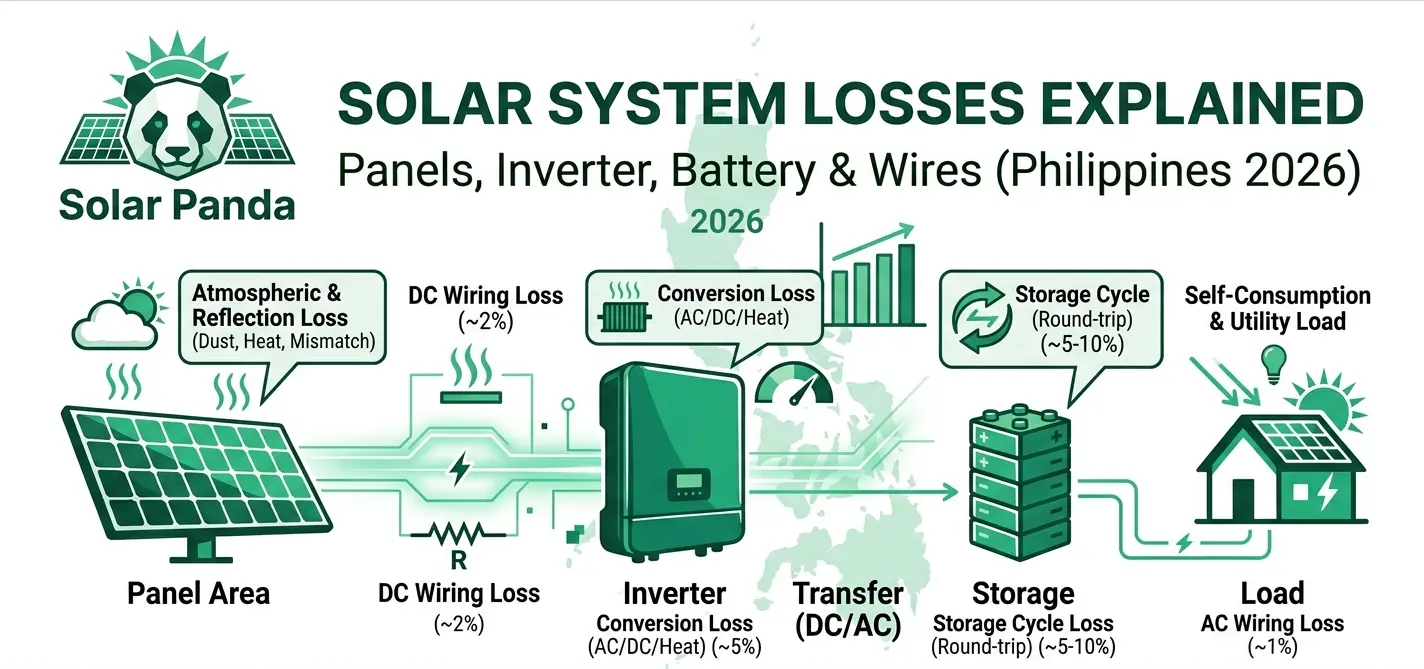
When someone says “I bought 3 kW of panels but the app only shows 2.2–2.5 kW,” that is usually not a scam — it is system loss stacked on top of real-world weather. A solar path is a chain: sun → panels → DC wiring → MPPT/charge control → battery (if any) → inverter → AC wiring → loads. Every link keeps a small (or not-so-small) share of the energy.
This article breaks down typical loss ranges, what counts as acceptable in sensible home designs, and practical habits that keep losses predictable — especially in Philippine heat, humidity, and brownout-driven battery use.
Key takeaway
Panel harvest rarely hits the sticker wattage under hot roofs; DC wiring should stay near a low single-digit percent if sized right; inverters lose a few percent converting DC→AC; batteries lose energy on charge and discharge; standby power adds a hidden daily tax. A well-built system does not remove loss — it manages it.
Why “nameplate watts” is not what you see at noon
Solar modules are rated at STC (Standard Test Conditions): bright light, 25°C cell temperature, and a specific lab setup. On a Philippine roof in the afternoon, the cells can run much hotter than 25°C. Most panels lose a bit of efficiency for every degree above that — the temperature coefficient on the datasheet tells you how much.
Other harvest losses:
- Shading — even partial shade on one part of a string can drag down the whole string’s useful output.
- Dirt and dust — pollen, ash, and bird droppings block light; coastal salt spray can film panels.
- Tilt and azimuth — panels that face the wrong direction or lie too flat still work, but peak output shifts and annual energy may drop.
- Clouds and rain — see peak sun hours for how Philippine weather affects daily energy.
Acceptable ballpark (instantaneous power at solar noon, good conditions): seeing roughly about 70–90% of the panel’s STC wattage as real-time DC output can be normal, depending on heat, wiring, and MPPT. Annual energy is a better metric than one moment on a meter — that is why designers use kWh/day or PSH instead of staring at a single “W” reading.
Tips: prioritize shade-free layout, elevated mounting with airflow, cleaning every few months (or after ash storms), and correct tilt/azimuth for your roof. If you are buying, ask for an estimate in kWh per month, not only “kWp installed.”
DC wiring loss (panels → combiner → inverter)
Current through any wire meets resistance R; power wasted as heat scales roughly with I²R. On the DC side, designers often aim for a low voltage-drop budget so the inverter’s MPPT sees a stable voltage window and you do not waste harvest as heat in the cable.
Industry rules of thumb (used in many PV designs and energy models) treat about 2% DC voltage drop from array to inverter as a design target, with ~3% sometimes used as a practical upper bound for branch circuits — always verify against local code, manufacturer limits, and temperature (hot wires increase resistance).
What pushes DC loss up:
- Long panel-to-inverter runs
- Undersized copper (saving too much on wire)
- Loose or corroded terminals and MC4 connectors
- Cheap CCA or fake cable that does not match spec
Acceptable: aim to design for ~2% or less; investigate if you measure or estimate above ~3% on a new DC circuit (before you blame the panels).
Tips: shorten runs where possible, step up conductor size, torque terminals properly, and buy quality copper from trusted suppliers. For battery-to-inverter DC, our breaker sizing guide pairs with our wire size chart — both must match.
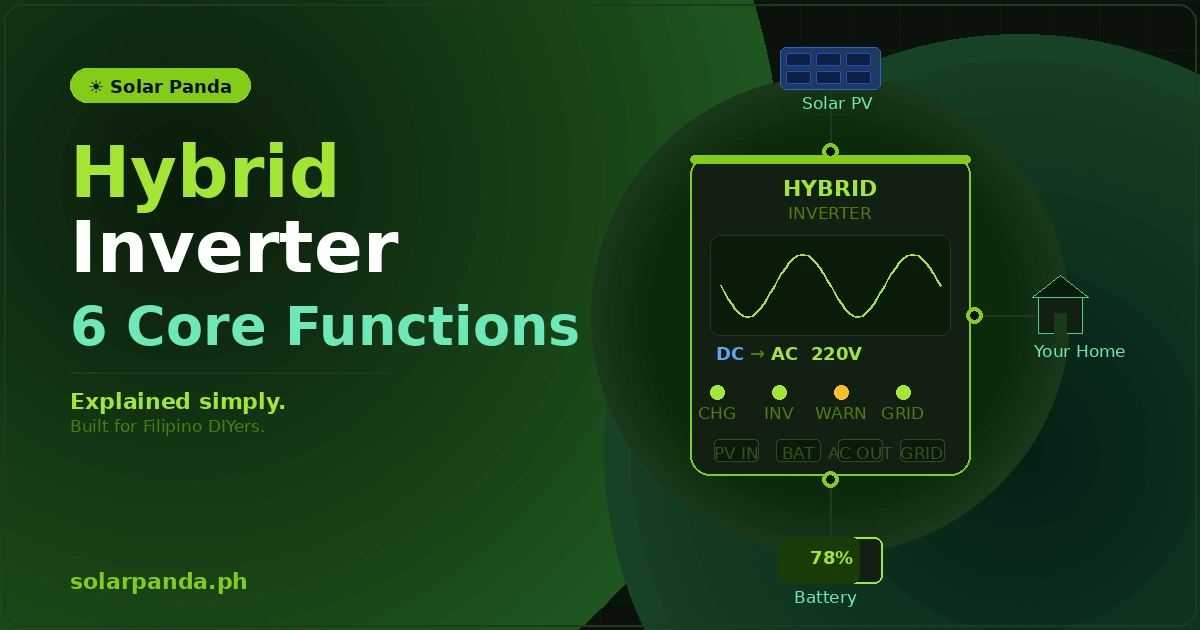
Hybrid inverter: DC conversion, MPPT, and AC output
A hybrid inverter combines solar input, battery charging, and grid-tie or backup in one box. Losses show up as:
- MPPT / charging stage — modern MPPT controllers are usually very efficient (often ~95–99% in the datasheet), but heat, input voltage limits, and battery voltage still matter.
- DC → AC conversion — good residential inverters often quote peak efficiency around ~95–97%, while weighted efficiency (real mix of power levels) is a bit lower.
- Standby / self-consumption — the inverter keeps electronics alive 24/7: fans, relays, monitoring. That idle draw is easy to forget when you size batteries.
Acceptable: for conversion efficiency, ~90–96% end-to-end from the DC input power to AC output at reasonable load is a common range for quality equipment — read the datasheet for your exact model. Idle is not a “percent” of solar; it is watts, 24 hours a day. A model that idles at 30 W burns ~0.72 kWh/day just standing still.
Tips: install in a cool, ventilated space; avoid oversizing the inverter far beyond your typical load (efficiency curves often sag at very low load); disable unnecessary accessories if the manual allows; compare idle watts when shopping.
For context on hybrid vs standard inverters, see inverter vs hybrid inverter (Philippines).
Battery loss (charge and discharge)
Batteries are not perfect storage. Round-trip efficiency is: energy you get out ÷ energy you put in — over a full charge/discharge cycle, including BMS and heat.
Typical ranges (rules of thumb):
- LiFePO₄ (lithium iron phosphate): often roughly ~90–95% round-trip in healthy systems when operated within manufacturer specs.
- Flooded / sealed lead-acid: often roughly ~70–85% round-trip depending on depth of discharge, temperature, and maintenance (watering, equalization).
What increases loss:
- Deep discharge (especially lead-acid)
- High charge/discharge rates (more I²R heat inside cells and busbars)
- Heat — batteries degrade faster and may need more cooling or spacing
- Wrong charging voltages (CC/CV, absorption time) — follow the BMS or battery manufacturer
Acceptable: treat ~5–15% round-trip loss as a normal planning band for LiFePO₄ in home systems; lead-acid can be higher unless you are conservative.
Tips: size Ah so you are not hammering the battery daily; keep temperature in spec; calibrate your SOC sense if you use it for decisions; read battery types in the Philippines for chemistry trade-offs.
AC wiring loss (inverter → breaker → loads)
After the inverter, AC current still runs through cable, breakers, and contacts. The same physics applies: resistance and length cause voltage drop and I²R loss.
Acceptable: many residential guides aim for ~2–3% voltage drop on branch circuits (or ~5% total feeder + branch in some references). If you hear buzzing breakers, warm cables, or large voltage sag under load, stop and get a licensed electrician — that is not a normal “efficiency loss.”
Tips: use breaker and wire sizes that match the continuous load; keep inverter-to-panelboard runs reasonable; avoid daisy-chaining extension cords for permanent loads.
Putting it together: realistic “stacked” expectations
No single number fits every roof — but models like PVWatts and similar tools often use default loss budgets in the ~10–20% range from nameplate DC to AC for grid-tied systems, before you add battery round-trip and idle on hybrids.
Rough mental model (not a guarantee):
- Grid-tied, no battery: you might end up with roughly ~75–90% of the STC energy potential making it to AC over a year, depending on equipment, climate, and design.
- Hybrid with daily battery cycling: battery + idle can move your “useful energy” lower — planning for ~60–80% of what the panels could do in ideal lab conditions is a conservative way to think about whole-system energy — not a defect.
| Stage | Typical loss (rule of thumb) | What “good” looks like |
|---|---|---|
| Panel harvest vs STC | ~10–25% below STC at peak (heat, dirt, mismatch) | Clean panels, no shade, realistic kWh forecasts |
| DC wiring | ~1–3% if designed | Short runs, correct gauge, good terminals |
| MPPT / charging | ~1–5% (equipment-dependent) | Voltage within MPPT window, cool gear |
| Inverter DC→AC | ~3–10% (load-dependent) | High-efficiency unit, not chronically underloaded |
| Battery round-trip | ~5–30% (chemistry + use) | LiFePO₄, conservative DoD, correct charging |
| AC wiring | ~1–3% typical design | Proper wire/breaker, no hot spots |
| Idle / standby | Fixed watts × 24 h | Low idle inverter, smart scheduling |
Beginner mistakes that inflate losses
- Saving on wire — the #1 DIY “savings” that burns watts and can fail safely.
- Shade on one string — disproportionate harvest loss.
- Wrong inverter — too big for typical load (low efficiency island) or too small (constant clipping).
- Battery abuse — deep daily discharge on lead-acid with weak charging.
- Ignoring idle — a 50 W idle is 1.2 kWh/day — 36 kWh/month you never see on the loads.
Bottom line
Solar is not broken when your instant watts are below the panel sticker. Losses are normal; the goal is to know them, budget them in design, and avoid cheap mistakes that turn “small loss” into big fire risk or dead batteries. When you want numbers tied to your bill and loads, use our tools and honest load counting first.
Plan with real load and kWh
Pair your expected losses with a realistic monthly consumption picture before you size panels and batteries.
Open monthly consumption calculator