Philippines DIY12V vs 24VSafety first2026 Guide
12V vs 24V Solar Setup: Which One Should You Choose?
Philippines · 2026 · By Solar Panda
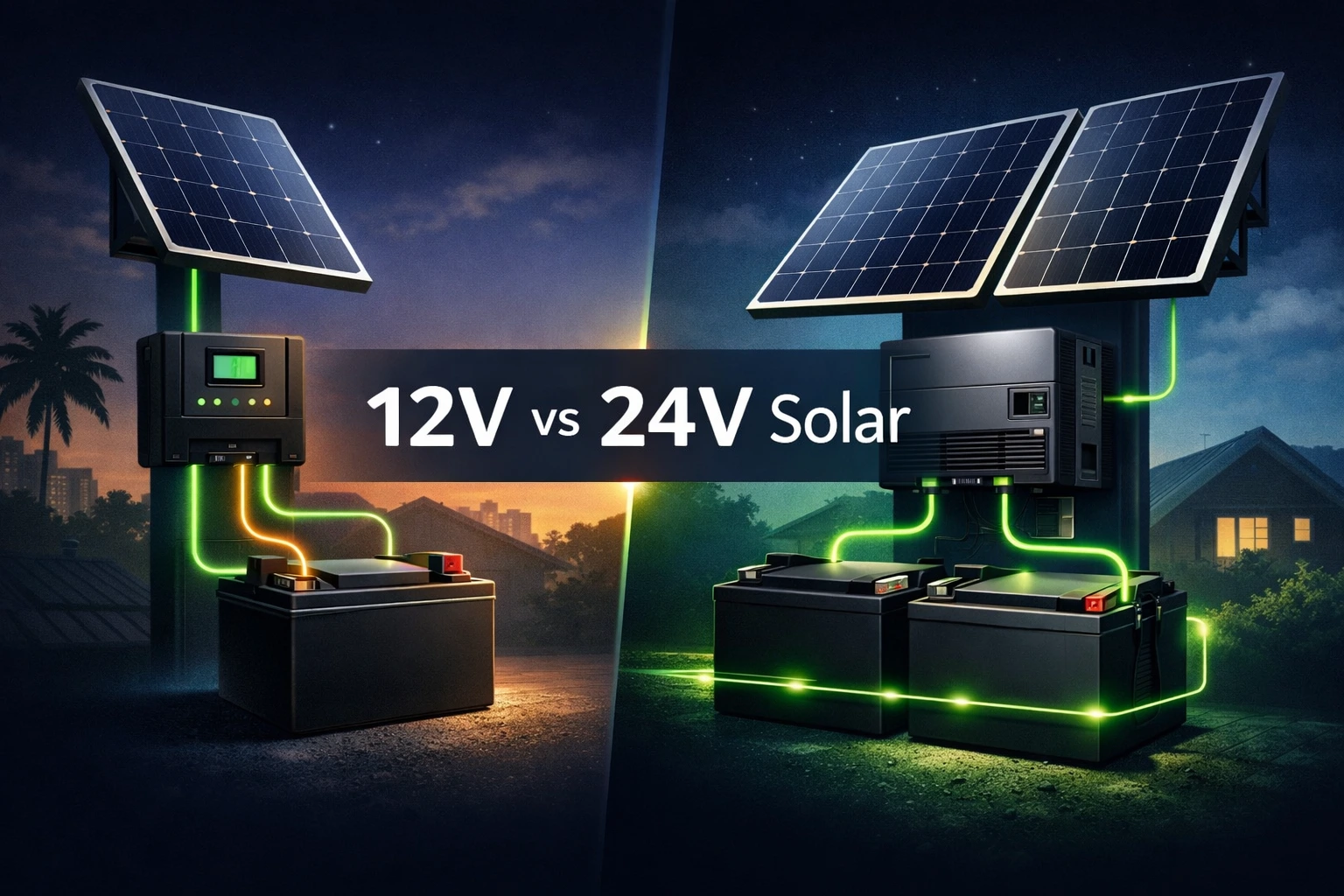
If you are planning a DIY solar or battery backup in the Philippines, one of the first locked-in decisions is the nominal DC voltage of your battery bank — usually 12V or 24V for small-to-medium home projects. It is not just “more power.” It sets DC current for a given wattage, which drives wire gauge, fuse/breaker ratings, terminal heating, voltage drop on long runs, and whether your charge controller and inverter are a sensible match for the load you actually run.
This guide compares 12V and 24V on current, wiring, protection, parts availability, and upgrade path, with a safety-first frame. Size fuses and breakers to manufacturer guidance, use the correct wire gauge, and when in doubt, consult a licensed electrical practitioner — especially for anything tied to your main house wiring.
TL;DR
12V fits compact backup (lights, router, small fan) where parts are cheap and DC runs stay short. 24V is the usual step when you are targeting roughly 500W–2000W class inverters and heavier cycling: for the same watts it pulls about half the DC amps versus 12V — so smaller copper for the same loss budget, cooler terminals, and less aggressive protection sizing — if the rest of the design matches the datasheets.
Why your battery voltage matters (before you buy anything)
Your inverter, solar charge controller (often MPPT), and battery bank must be a matched system: same nominal bus voltage, correct SCC max voltage and current, inverter DC input range that fits your battery chemistry. The battery rail sets I = P / V (approximately) for a given DC power — so more amps means more I²R loss in cable, more heat at lugs, and more demand on overcurrent protection. Voltage choice is a thermal and protection-design problem, not only a sticker price problem.
!
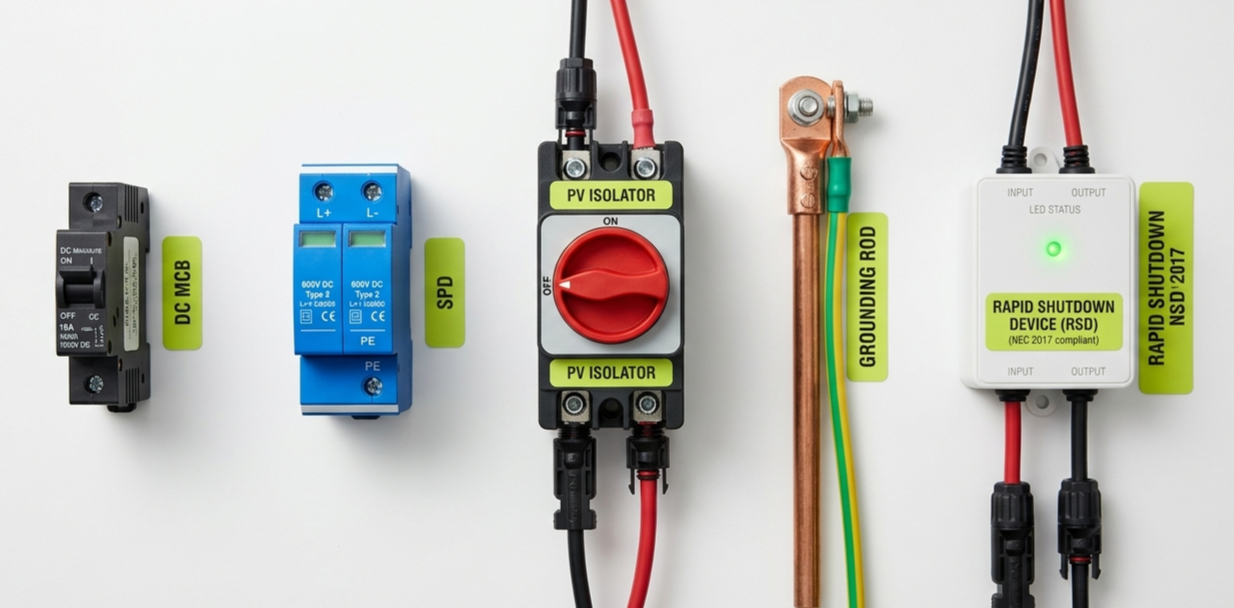
Safety first: Never mix random breakers, random wire sizes, or mismatched inverter/SCC voltage settings. Overloaded conductors and loose lugs are real fire risks. Our guides on breaker sizing and MCB vs MCCB explain the basics — follow them alongside your equipment manuals.
12V system
12V battery bank
Lower bus voltage, higher amps per watt
Advantages
- Lower parts cost: 12V inverters, PWM or MPPT controllers, and single 12V batteries are widely sold — Lazada/Shopee and local shops — so pricing stays competitive.
- Minimal stack: One 12V battery, one inverter, one SCC — fewer series connections to get wrong on a small footprint.
- Common parts: Fuses, lugs, and small MCBs are easy to find; in provincial areas that cuts downtime when something fails.
- Suits light loads: LED, router, phone charging, small DC fan — realistic on a correctly sized 12V bank if you keep continuous amps honest.
Disadvantages
- Higher DC current: Same watts → more amps than 24V. You need heavier gauge or shorter runs, or you accept voltage drop and connector heating.
- Voltage drop on long runs: Battery-to-inverter distance at 12V punishes undersized cable; “it works at idle” is not the same as “it works at full load.”
- Heavy loads get ugly fast: Ref, pump, stacked appliances → amp draw and surge on 12V climb quickly; margin for error shrinks.
- Scaling often means a voltage change: Growing from a minimal 12V rig to a larger backup often forces new inverter/SCC or full rewiring — worth deciding early.
- Inverter ceiling: Many budget 12V units cap out at moderate output; if your load table grows, you hit hardware limits before you hit panel count.
24V system
24V battery bank
Series pairs of 12V cells, or 24V batteries
Advantages
- Half the amps (same watts): 24V ≈ 50% of 12V current for the same DC power — smaller conductor for the same drop target, cooler lugs, saner breaker curves — if everything is specced to the manual.
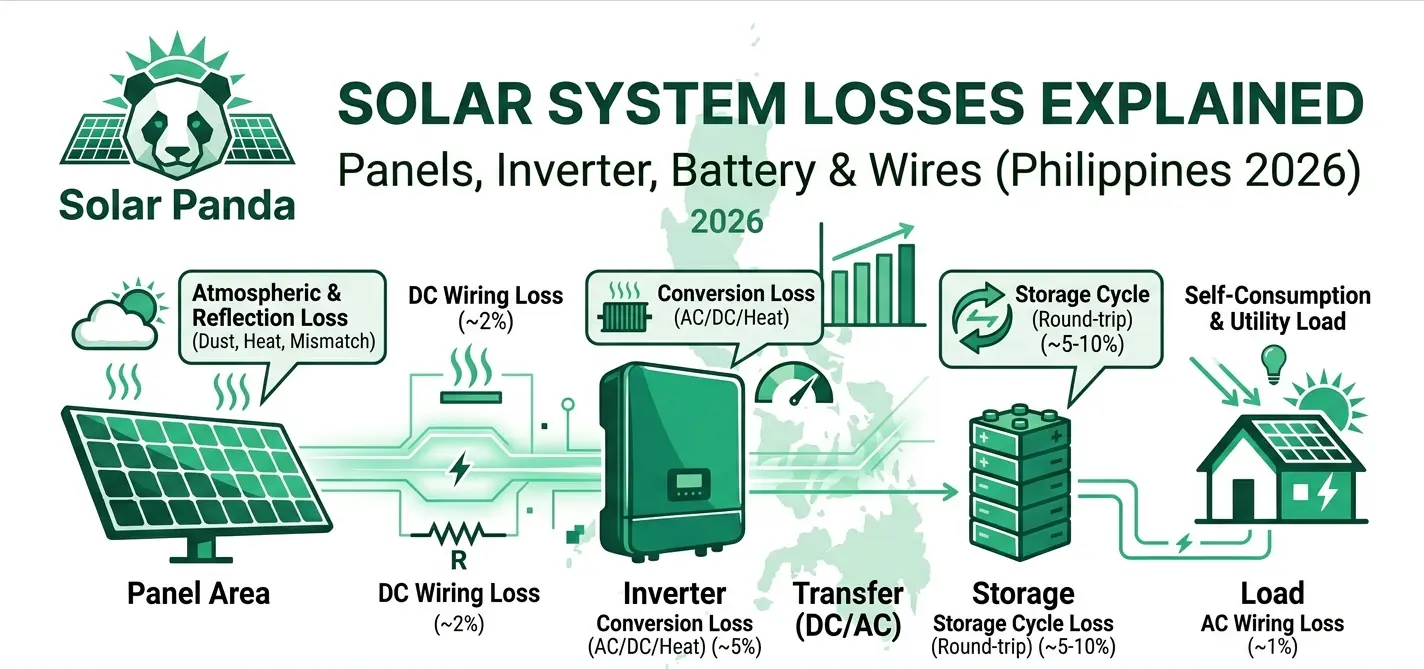
- Less I²R waste: Lower current through the same resistance means less heat in cable and connections — that matters when you are stretching Ah across multi-day brownouts.
- Less voltage drop on longer runs: For the same cable size, 24V tolerates DC runs a bit better — still not unlimited, but more forgiving than 12V.
- Handles bigger loads: Typical home backup targets — ref, TV, small pump, more fans — often land you in an inverter class that is more commonly spec’d at 24V in the Philippine market for medium DIY builds.
- Easier to scale: Adding panels, a bigger MPPT, or more battery capacity often fits more naturally once you are already at 24V.
- Better inverter options at higher wattage: If you are shopping hybrid or high-surge inverters for startup loads (like refrigerator compressors), 24V (and 48V) product lines often dominate.
Disadvantages
- Higher initial cost: You may need two 12V batteries in series, or a dedicated 24V pack — higher upfront battery spend versus a single 12V block.
- Series discipline: Two 12V in series (or a 24V pack) needs correct polarity, matched cells, and per-leg fusing where required — mistakes cost equipment or people.
- More configuration surface: Lithium BMS limits, lead-acid equalization, SCC absorption/float profiles — all have to match the bank you actually wired.
- Some parts less common than 12V: The gap is shrinking in 2026, but always confirm local stock for your exact inverter/SCC model before you commit.
Side-by-side snapshot
| Topic | 12V | 24V |
|---|---|---|
| Typical PH use | Small backup, lights, router, fan | Medium home backup, ref + more loads |
| DC current (same watts) | Higher amps | About half the amps vs 12V |
| Wire sizing | Often thicker for the same power | Often thinner vs 12V (still must calculate) |
| Cost curve | Lower entry | Higher entry, better scale path |
Quick rule of thumb (Philippines context)
These bands are rules of thumb — your inverter surge, battery Ah, and duty cycle still rule — but they track how PH builds usually split:
- 12V: Often under ~500W inverter class: basic outage loads — lighting, Wi‑Fi, phone charging, small fan — where the bill stays low and DC paths stay short.
- 24V: Often ~500W–2000W class: ref + fans + TV + router and similar, with load staggering — the market’s medium backup tier leans 24V (or 48V) for a reason.
If the watt class is unclear, build a load table: nameplate watts, inrush/surge, and what must run simultaneously. Our starter parts guide maps the stack, and typical PH price bands for 12V vs 24V builds anchors cost.
Same power, different current (the insight that saves money and risk)
Electrical power in DC is roughly power (watts) = voltage (volts) × current (amps). If you hold power constant and double the voltage, you halve the current.
Worked example — 1200W from the battery bus (idealized, before inverter loss):
- At 12V, about 100A DC.
- At 24V, about 50A DC.
Why that matters on the bench:
- Lower amps → smaller conductor for the same voltage-drop budget, cooler terminations, and protection gear that is easier to source — if the design follows *datasheets and local rules.
- Higher amps at 12V forces short runs, heavy lugs, and torque discipline. Undersizing any of that is how systems fail under load.
Formula: Amps ≈ Watts ÷ Volts. 12V → 24V at the same watts ≈ half the amps — a big reason medium home backups in the Philippines land on 24V once the load table grows.
Reality check: Inverters are not 100% efficient, and batteries sag under load. Always use manufacturer specs + safety margins — not napkin math alone — when picking wire and breakers.
Safety checklist (non-negotiable)
- Match voltages: SCC, inverter/charger, and battery bank nominal voltage must be consistent with how you wire cells (series/parallel).
- Size DC protection: Undersized wires or oversized breakers are dangerous. Read battery-to-inverter breaker sizing.
- Torque and inspect: Loose battery terminals arc. Re-check torque after the first week of use.
- Ventilation & chemistry: Lead-acid needs airflow rules; lithium needs BMS integrity. Never improvise charging profiles.
- Know when to stop DIY: If you are connecting to house mains, doing line-side work, or your loads are unclear, hire a licensed professional.
⚠
Brownout season reality: Filipino homes often stack loads during outages. A 24V system does not magically allow “everything at once” — load priority and battery capacity (Ah) still decide runtime. Voltage choice helps efficiency and safety; it does not replace math.
Try the calculators with voltage preset
Use the Solar Panda kW calculator to explore realistic parts lists with voltage locked in — compare a 12V-oriented starting point versus a 24V home backup build:
Adjust watts in the tool to match your load plan — the goal is not the exact links above, but the habit of pairing voltage + load + protection together.
Plan your voltage, wires, and breakers together
Stress-test 12V vs 24V parts lists against your load table before you commit — fewer mismatched orders, safer margins.
Open kW calculatorBottom line
Choose 12V when parts cost and a minimal stack matter most, loads stay light, and DC paths stay short. Choose 24V when you are sizing for medium home backup, want lower DC current for the same watts, and expect higher-watt inverters or future panel/battery growth. Either way, design for peak amps, fuse every leg, and treat the install as regulated electrical work — because it is.