5 Essential Safety Components Every DIY Solar Setup Needs
Solar wiring is not like plugging in an appliance. DC current from batteries and solar panels is continuous — it does not zero-cross like household AC. A fault in an unprotected DC circuit will arc, heat, and burn until the cable melts or a fire starts. The five components in this guide exist for one reason: to interrupt that fault before it becomes a disaster. Every single one is non-negotiable.
At a Glance
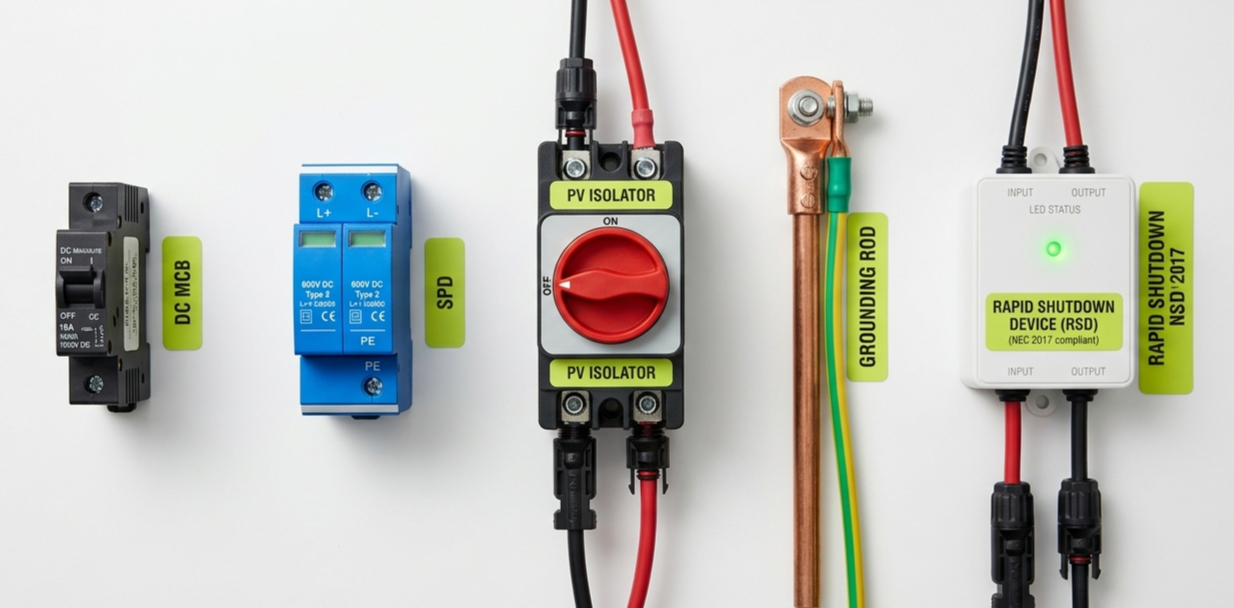
| Component | Role | Where It Goes |
|---|---|---|
| Circuit Breaker (MCB/MCCB) | Overcurrent & short-circuit protection | DC: battery → inverter; AC: inverter → load panel |
| Surge Protection Device (SPD) | Voltage spike suppression | DC: PV string; AC: inverter output |
| Isolators | Manual de-energization | Battery line, AC output, PV string |
| Grounding | Fault-current path to earth | All metallic enclosures and frames |
| Rapid Shutdown Device (RSD) | Emergency PV array de-energization | Rooftop PV string |
⚡ 1. Circuit Breaker (MCB / MCCB)
A circuit breaker is the first and most critical protection component in your system. It monitors current flowing through a conductor and trips — mechanically opening the circuit — the moment current exceeds its rated value.
You need breakers in two places:
DC side (battery → inverter): This is the highest-risk point in most DIY setups. A battery bank can deliver thousands of amperes into a dead short. Without a correctly sized DC breaker, a wiring fault becomes an immediate fire hazard. Standard household AC breakers must not be used here — they are not rated to interrupt a DC arc.
AC side (inverter → load panel): Protects your downstream household wiring from inverter output faults.
Always apply a 25% safety margin when sizing — never run a breaker at 100% of its rated load. A breaker that runs hot is a breaker that fails early.
⚠️ Warning: A DC short without a breaker will not self-extinguish. The arc sustains itself and will burn through wiring, terminals, and enclosures until something physically interrupts it.
Read our deep-dive on MCB vs MCCB to pick the right type for your setup, and use the Breaker Sizing Calculator to get the exact amperage. See also: how to size the DC breaker between your battery and inverter.
Where to Buy

DC MCB (6A–63A)₱350


DC Wide MCB (80A–250A)₱600

AC MCB (6A–63A)₱200
🛡️ 2. Surge Protection Device (SPD)
A Surge Protection Device clamps transient overvoltages before they reach your inverter, charge controller, or battery BMS. In the Philippines, where typhoons and lightning strikes are a seasonal reality, this is not optional.
Install SPDs in two locations:
- DC SPD on the PV string, wired between the panels and the hybrid inverter or charge controller
- AC SPD on the inverter output, before the load panel
A single lightning strike near your roof can inject thousands of volts into your PV wiring. Without a DC SPD, that spike travels straight into your inverter — destroying it instantly. This is one of the most common and most preventable failures we see in DIY installs. Learn more about how it plays out in 5 Common Solar Setup Disasters.
💡 Tip: Replace your SPD after any confirmed lightning event in your area. SPDs sacrifice themselves to protect your equipment — they are not reusable after a major surge.
Where to Buy

DC SPD₱450

AC SPD₱288
🔌 3. Isolators (Battery, AC, and PV)
Isolators are manual disconnect switches. Unlike breakers, they do not trip automatically — their job is to give you a safe, deliberate way to de-energize a section of your system before you touch any wiring.
Battery (DC) isolator: Disconnects the battery bank from the inverter. Before any work on your DC wiring, this must be open and confirmed off.
AC isolator: Disconnects the inverter's AC output from your load panel. Required before working on any downstream AC circuitry inside the house.
PV isolator: This is the one most DIY builders overlook. Solar panels generate voltage any time there is light — even on an overcast day. There is no switch on a solar panel. The PV isolator is the only way to safely break the circuit between your array and the inverter or charge controller during daylight hours.
⚠️ Warning: Skipping the PV isolator means your system is permanently live during daylight. Any wiring work on the PV side without it puts you in contact with live DC voltage — with no way to shut it off.
Where to Buy

DC Isolator Switch₱159

AC Isolator Switch₱1,350

PV Isolator Switch₱3,600
🌍 4. Proper Grounding
Grounding bonds every metallic surface in your system — panel frames, mounting rails, inverter chassis, battery enclosure — to earth. Its purpose is direct: if a live conductor ever contacts any metal surface, the fault current flows to ground instead of through whoever touches the enclosure.
In the Philippines, the standard is a copper-clad steel ground rod driven at least 1.5 meters into the soil. All grounding conductors must be appropriately sized for the fault current your system can produce.
Do not skip or undersize grounding because the system "seems fine." Insulation degrades over time, especially when exposed to the tropical heat and humidity of a Philippine climate. Ground faults are invisible until they are lethal. Rooftop installations and outdoor enclosures accelerate this risk significantly — see how wet installations create ground fault conditions.
Where to Buy

Ground Rod₱2,000

Ground Clamp₱100

Ground Wire₱2,600
🛑 5. Rapid Shutdown Device (RSD)
A Rapid Shutdown Device allows emergency personnel — firemen, paramedics, emergency responders — to de-energize your entire rooftop PV array from a safe location, typically from ground level, within seconds.
Without an RSD, solar panels on a burning structure remain live as long as there is daylight. Firefighters cannot safely approach the roof. Emergency crews cannot safely cut into the structure. The panels simply keep producing voltage, indefinitely.
RSDs are now required by electrical code in many countries and are increasingly mandated for hybrid grid-tied systems. If you have a rooftop array connected to a hybrid inverter, an RSD is not a future consideration — it is a present requirement.
✅ Pre-Energization Safety Checklist
Before your system goes live, confirm every item:
- ✅ DC breaker between battery bank and inverter — rated for DC voltage, sized with 25% safety margin
- ✅ AC breaker between inverter output and load panel
- ✅ DC SPD on PV string; AC SPD on inverter output side
- ✅ Battery isolator, AC isolator, and PV isolator installed and clearly labeled
- ✅ All metallic enclosures and panel frames bonded to a proper earth ground rod
- ✅ RSD installed and accessible to emergency responders
Build It Right the First Time
Safety components are a small fraction of your total system cost. A single fire, a destroyed inverter, or an electrical injury costs far more than the full set of protection hardware combined.
If you're still in the planning stage, start with our complete DIY solar parts guide. When you're ready to size your breakers correctly, use our Breaker Sizing Calculator.
For questions, email us at solarpanda.ph@gmail.com 📩